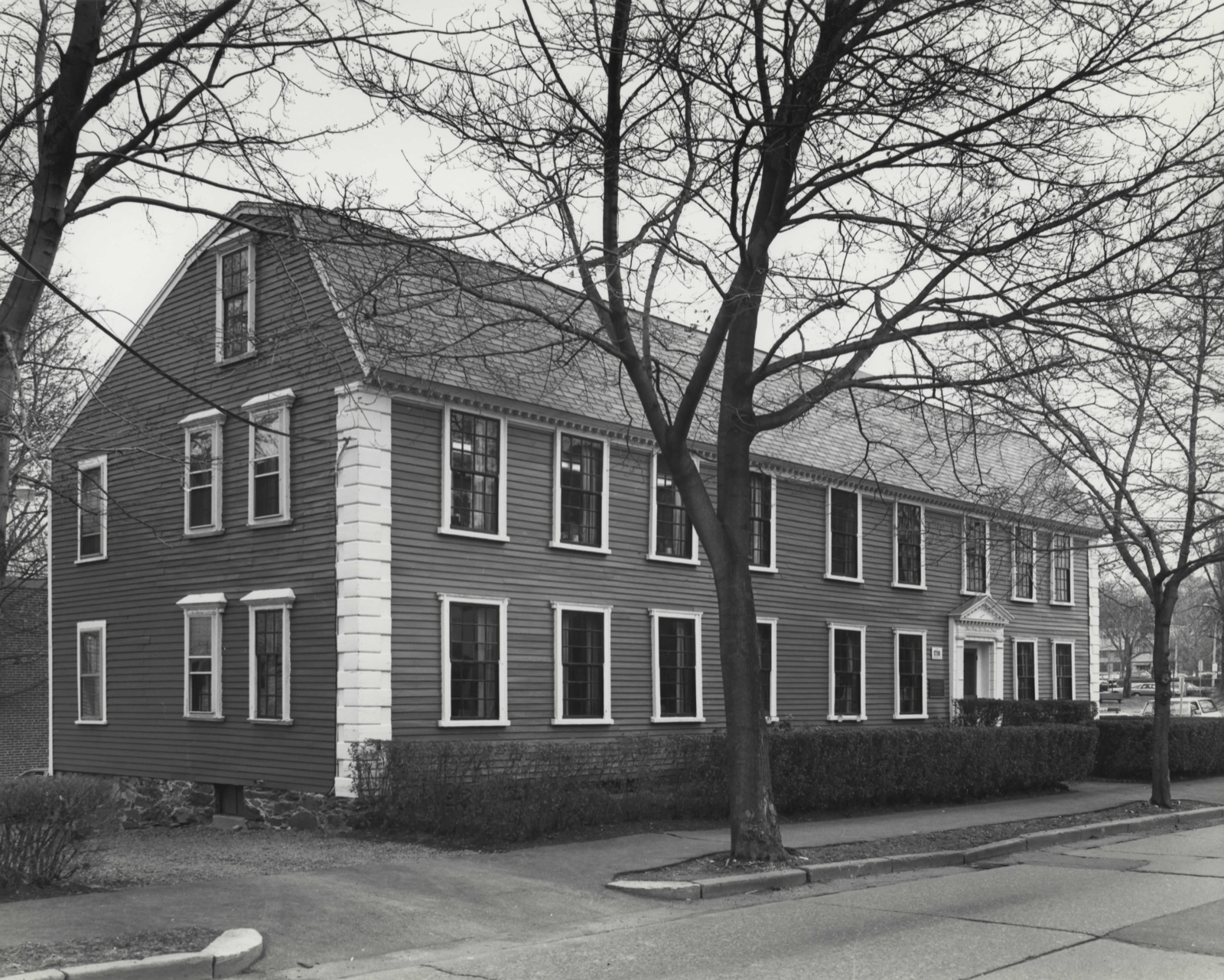
Photographs from the nomination case file, National Park Service records.
Warren, Dr. Samuel, House
Listed on the National Register of Historic Places in
1985. A historic map-sheet match is not published yet. The record needs a coordinate-quality review before it can be joined to a sheet boundary.
From the record
one of 1100 National Register listings in Middlesex County · listed in 1985 · category: Building · one of 3 National Historic Landmarks in Middlesex County.
National Register reference number.85000028- the number the National Park Service assigned this property when it was listed, and the key its nomination file is catalogued under at the National Archives.
Storms near this property
17 since 1997
Regional context, not property-specific
evidence. The National Weather Service names
Newton, the town this property stands in, in 17 storm reports between 1997 and 2025: 8 thunderstorm wind, 4 hail, 3 flood, 1 flash flood.
The reports record 1 injury. Each account below is quoted exactly as the forecast office
filed it, from the NOAA Storm Events Database, and each date
opens the federal record of that event.
A 62-year old woman was struck by lightning. She endured a side flash after lightning struck a tree near her. She was alert and breathing at the scene but was transported to a hospital for further evaluation.
In Newton, a tree was down on a car near 1750 Commonwealth Avenue. Also, a tree was down on a house at 111 Prospect Street. A tree was down on Park Drive. A tree was down on Adams Street at Wiltshire Road.
In Newton, urban flooding caused two cars to have to be removed from flood waters near 100 Walnut Street. Also, Adams Street was flooded and impassable from Watertown Street (Route 16) to Cottage Court.
In Newton, a 20 foot stretch of Beacon Street was flooded with 1 foot of water. Also, Route 9 at the Parker Street underpass was flooded with 6 to 12 inches of water. Route 9 westbound near the Chestnut Hill Mall was flooded with 10 to 12 inches of water. In Natick, Speen Street near the Natick Mall was flooded with a foot of water. A few cars stalled out in the water.
After receiving two to three inches of rain with Tropical Storm Irene, the intersection of Commonwealth Avenue and Washington Street was impassable due to flooding in Newton. A car was stuck in flood waters on Commonwealth Avenue.
No historic map-sheet match is published
for this property yet. That does not mean no map exists. This record needs
a coordinate-quality review before it can be joined to a sheet boundary.
Browse the county's mapped places while that work is
pending.
From the nomination file
2,701 words on record
When this property was proposed for the
National Register, someone wrote the case for it: what the building is,
and why it matters. That document is a federal record in the public domain.
It is quoted below word for word, never summarised. The text was read off the scanned case file by machine, so the
occasional stray character is the recogniser's and the 1970s
typewriter's.
Description of the property
The Dr. Samuel Warren House, a Georgian-style residence built ca. 1716, originally stood on Washington Street in the center of West Newton. It was moved to its present location on Cherry Street, adjacent to the town center and business district of West Newton, in Flanked by closely trimmed hedges, the building now sits close to the street on a slightly sloping lot at the corner of Washington and Cherry Streets. There is a grass and stone driveway along the building's north side, and a small lawn and parking area on the east side. The present location is at the fringe of a residential area, and the building now houses an antiques business.
Built in three stages spanning a seventy-five-year period in the 18th century, the Warren House is now unusually long, extending nine bays along its main facade. The three bays at the right (a door and two windows) are the earliest portion of the building. Iwo bays at the center form the middle addition, while the four bays at left (at one time, five bays) are the final, and most extensive, addition. The building was somewhat modified in 1868, when it was converted to a multifamily residence, and again ca. 1960, when its 18th century appearance was restored and its interior was slightly altered for business pur poses. Decorative detailing is Georgian in character. The building presents a gambr el roof construction on its front elevation, but drops to a deep shed roof in the rear.
The Warren House rises 2 1/2 stories from a fieldstone foundation. The exterior is sheathed with narrow clapboards, and quoins define the building's corners. An off-center pedimented doorway-- a 20th century replacement--is flanked by Doric pilasters and a wooden architrave scored to imitate ashlar blocks. A modillion cornice tops the nine-bay facade.
(in one paragraph) Builder Architect William Williams BEETL The Dr. Samuel Warren House possesses integrity of design, materials, workmanship, feeling, and association. It is significant for its part in West Newton's community development, for its Georgian architecture, and for its three-part construction over a seventy-five-year period during the 18th century. It is the oldest of three colonial-period buildings surviving in West Newton and is associated with several individuals closely involved in the town's early development. Additionally, it is one of approximately a dozen extant colonial-period buildings in Newton. It has served several purposes since it was built in 1716-- single family dwelling, multifamily dwelling, commercial space and, possibly, tavern.
Its original owner/builder, William Williams, a local housewright, also built the Dr. Samuel Wheat House nearby on waltham Street, which has an identical roofline. The building thus meets criteria A, B, and C of the National Register for Historic Places at a local level. The town of West Newton in the 18th century consisted of a few buildings clustered around a town center and several outlying farms. The community was located along one of the ma jor roads to Boston, Old Natick Road (now Washington Street). William Williams built the oldest portion of the nominated property on Washington Street at the village center in about 1716.
Williams, a yeoman and well-known housewright in the village, purchased the Washington Street lot from his father, Isaac, one of the first settlers of West Newton. There he built a three-bay, side-entry home. He sold the building in 1732. Although many of West Newton's early homes were passed down from father to son, Williams' house changed family ownership numerous times, belonging to eight different families during the 18th century. In 1750, Dr.
Quoted from the National Register nomination
for reference 85000028, 11 pages, held by the National Archives in Record
Group 79. See the
catalogue record.
Listing record. National Park Service National Register of Historic Places, listed-properties dataset, current to 2026-05-22.
Map join. Address geocoded through the United States Census geocoder, then tested against the published boundary of every sheet in the USGS Historical Topographic Map Collection.
How this page is made. Listing fields come from federal records; map-sheet coverage is a labelled coordinate-to-boundary calculation, not a source-field claim.
Storms. NOAA National Centers for Environmental Information, Storm Events Database https://www.ncei.noaa.gov/stormevents/ A work of the United States government, no copyright under 17 U.S.C. 105. Narratives are quoted verbatim from the National Weather Service report and are not edited or summarised.
 Block
Block